|
P.O. Box 51063 Eugene Oregon 97405 |
|
Applied Bioacoustics is a service company dedicated to improving appreciation and conservation of animals in the wild, by means of the sounds they produce in their normal activities. The company is a sole proprietorship, operated by Arch McCallum. For several years we have been developing spectrogram-based tools to help birders and wildlife biologists improve their ability to identify birds by the sounds they make. Follow links below to get the flavor of this work. Or, contact us. |
|
Diana Byrne Captures Oregon's First Recording of an Allen's Hummingbird Dive Sound
|
|
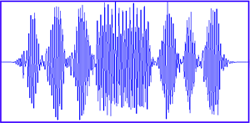
Diana Byrne of Portland, a frequent poster on OBOL, the "Oregon Birders On Line" list, posted a link on 4/8/12 to video of an Allen's Hummingbird dive display recorded near Brookings, Oregon. I came across the post on 4/13/12 as I prepared for another trip to the south coast in hopes of getting a sound recording of that very behavior. I redigitized the sound track from the streaming video, and prepared a sound spectrogram ("sonogram") of the dive sound. Diana's recording is in the middle below (you can hear the sounds by clicking on individual sonograms), flanked by samples recorded by Chris Clark, the noted hummingbird biomechanics specialist, who discovered the mechanism used by Anna's Hummingbird to produce its dive sound while a Ph.D. student at Berkeley. He's now a postdoc at Yale, but before he left the west coast he also did experiments on Allen's in California and recorded Rufous in Oregon. The recording of a Rufous, on the left, was obtained at Waldport on 4/20/2009. Chris's recording of an Allen's, on the right, was recorded in the Bay Area on 4/13/09. Diana's bird is in the middle. It clearly resembles the Allen's more. Using both field experiments and a wind tunnel study, Chris determined that the third tail feather in from the edge, R3, is responsible for the bottom band on the Allen's sonogram. This band is marked below (right) with a bold blue arrow. Most of the bands above it are harmonics of that fundamental frequency (finer blue arrows). But there is a steeply descending band between 8 and 10 kHz that cannot be a harmonic of that R3 fundamental, because it is not parallel to it. His experiments showed that this band, marked with a bold red arrow, is made by R4, which is one feather in from the very narrow feather on the outside. Even jazzier are the two bands marked with purple arrows. They are parallel to the R4 (red) fundamental because they are sidebands of it. Sidebands are caused by the physical interaction of sound sources that are vibrating at different frequencies. I hypothesized, on the basis of frequency measurements of the two fundamentals, that the sidebands were produced by interactions between adjacent feathers, and Chris’s experiments elegantly confirmed the prediction. See his paper in Science (link above) for a beautiful presentation of these results. |
|
Allen's, Brookings, Oregon
Recording © Diana Byrne
|
|
The point of going into all this detail is that Diana's bird has the R3 fundamental (bold blue arrow) at just below 2 kHz (marked with a horizontal red line on all the sonograms), the right spacing of at least two harmonics above it (fine blue arrows), and the separate and descending R4 fundamental between 10 k and 8 k (bold red arrow). I cannot make out any sidebands on this sonogram, but I see some faint traces in the right places that could be them. Its introductory notes are also evenly spaced, like the Allen's, while those of the Rufous accelerate. Note the very different appearance of the Rufous from Waldport. Its lowest band, presumably the R3 fundamental, is at 750 Hz, and the other bands, which are at the correct frequencies to be harmonics of the lowest band, are very closely packed. I'm on the lookout for hybrids, but it sure looks to me like Diana's Brookings bird is a good Allen's. That said, it is audibly lower in pitch to my ear than the Allen's from California, and you can see that on the sonogram, where the lowest band in the middle figure is a trace lower than the one on the right figure. But, that could be normal variation. Now, as to my claim that this is the first recording of an Allen's dive sound from Oregon, I welcome a refutation. I simply note that there is no recording of an Allen's Hummingbird in the online catalogs of the world's four major natural sound archives, namely Macaulay Library at Cornell, Borror Lab at Ohio State, the British Library, and Xeno-canto.org. It's hard to imagine that Geoff Keller lived in Coos County all those years and never got an Allen's, but I think that must be the case. His material should have been catalogued at Cornell years ago. Let me know if you know otherwise. |
|
And I Capture Oregon's First Recording of a Hybrid Allen's X Rufous Hummingbird Dive Sound
|
|
I recorded this dive sound 4/15/12 at the BLM's New River A.C.E.C. (Area of Critical Environmental Concern) in southern Coos County, Oregon. He was in the big patch of manzanita just north of the second junction of the Ridge Trail with the main trail that leaves the parking area and heads roughly north. This sound differs in several significant ways from either pure standard, and from the Brookings Allen’s. First, there is no sign of the high, descending R4 fundamental that is characteristic of typical Allen’s (pers. obs.) The part of the sonogram in which that sound would appear (red arrow) is in fact mysteriously devoid of any sound from the bird. I am tempted to hypothesize that his mixed parentage has left him with an R4 that is “mute,” a cost of hybridization that may make him unpopular with females and unsuccessful genetically. Second, although some of the partials (blue arrows) are mathematically consistent with the hypothesis that they are harmonics of the lowest band (bold blue arrow), there are also faint partials that are unexplained as harmonics (green arrows). One possibility is that R3 and R2 are tuned to the same frequency in Rufous, but not in this hybrid, and hence the harmonics of the two fundamentals are not quite at the same frequencies. Third, the introductory sounds, produced by rapid spreading and closing of the tail, are farther apart than in the two Allen’s samples, but still closer together than in Rufous. This calls for measurements of the pulse rate of these sounds in both parental populations to see if this bird lies in the range of either. All told, then, this sample resembles an Allen’s dive sound, but it is deficient in several ways, and all these deficiencies point toward the influence of Rufous genes. |
|
Possible Hybrid, New River, Oregon
Recording © Arch McCallum
|
|
What's Next?
|
|
Many more recordings are needed to map the range in Oregon of acoustically "typical" Allen's Hummingbirds, and to map the extent of the hybrid zone. You can help. All it takes is a video camera. If you can record a dive with your video camera and put it on the web, as Diana Byrne did, I can do the rest.
|
|
CONTENTS
|
|||||||
|